
Reviewed by the Ford-certified service team at Murgado Ford of Chicago. Last reviewed August 2026. Murgado Ford of Chicago is a factory-authorized Ford dealer at 2501 N Elston Ave in Bucktown, operated by Murgado Automotive Group. Our Ford-certified technicians use Ford IDS (Integrated Diagnostic System), FDRS (Ford Diagnostic & Repair System), and Genuine Ford Motorcraft Parts on every Bronco that comes through our Elston Ave service bay.
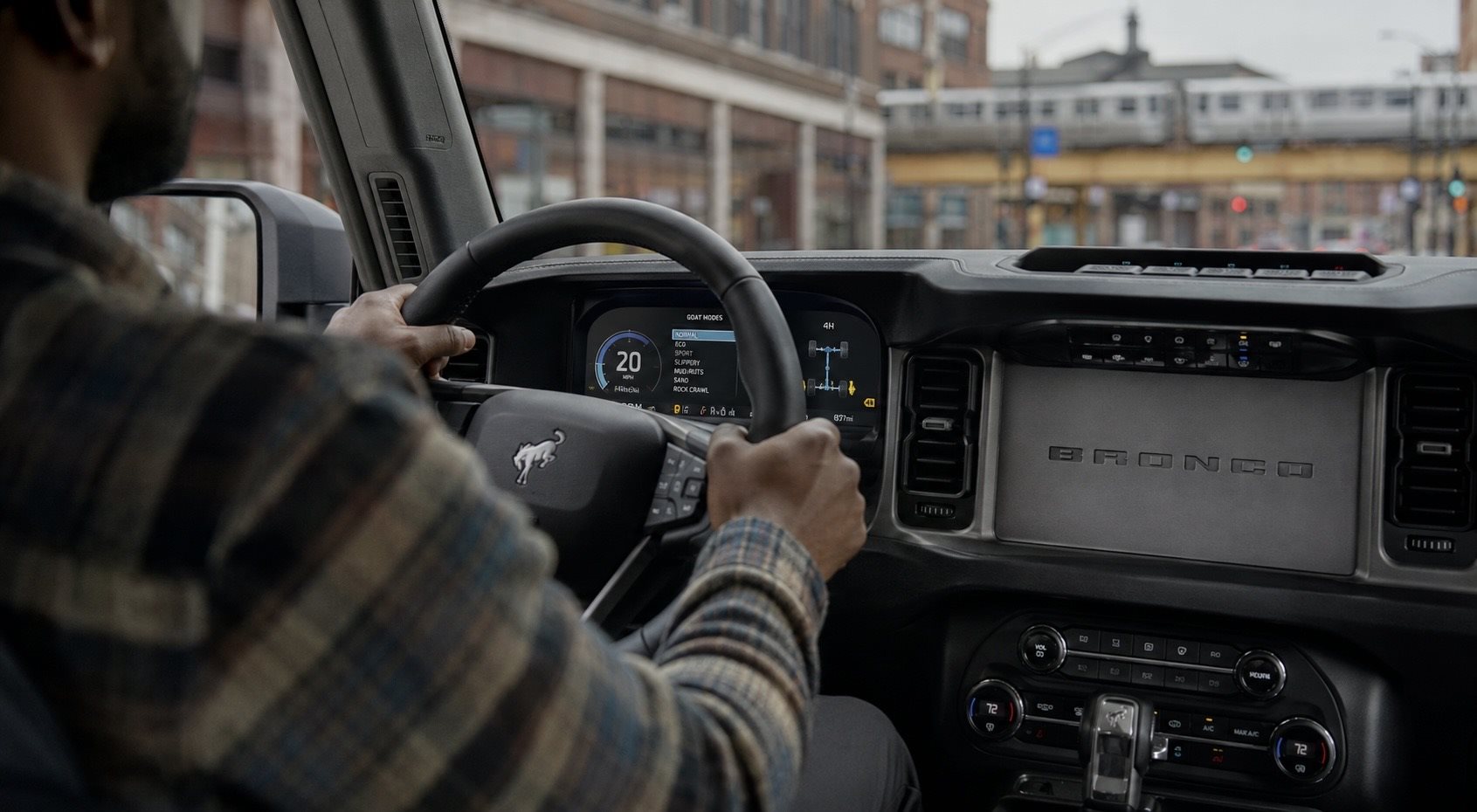
Most of the icons on a Ford Bronco's dashboard are the same ones you'd find on any modern Ford - but the Bronco adds a set of off-road-specific indicators that don't appear on an F-150 or Explorer: G.O.A.T. Mode status, front sway bar disconnect, low-range 4x4 engagement, Trail Control, and doors-off/roof-off indicators. Most of these are informational status displays, not warnings, and knowing the difference matters before you decide whether something means "keep driving" or "get it scanned." If a light is on right now and you're not sure which category it falls into, call our Bucktown service team at (779) 243-5517.
This guide covers the Bronco's standard red and amber warning lights, the off-road-specific icons unique to the model, what happens to the dashboard with the doors or roof removed, and the Chicago-specific patterns - salt belt corrosion, sub-zero cold starts, and the mix of city short-trips and weekend trail use - that can create recurring warning-light patterns for Broncos used both around town and off-road.
Bronco Warning Lights and Off-Road Indicators: What They Actually Mean
As a general rule, red indicators deserve immediate attention, amber indicators usually signal a condition that should be checked, and green, blue, or white indicators commonly show system status. The exact meaning and required action depend on the specific symbol and message shown in the cluster. The Bronco-specific twist is that several of its unique icons - like locking differentials or a disconnected sway bar - are informational status indicators, not warnings at all. Mistaking one of these status indicators for a warning is a common source of unnecessary service visits.
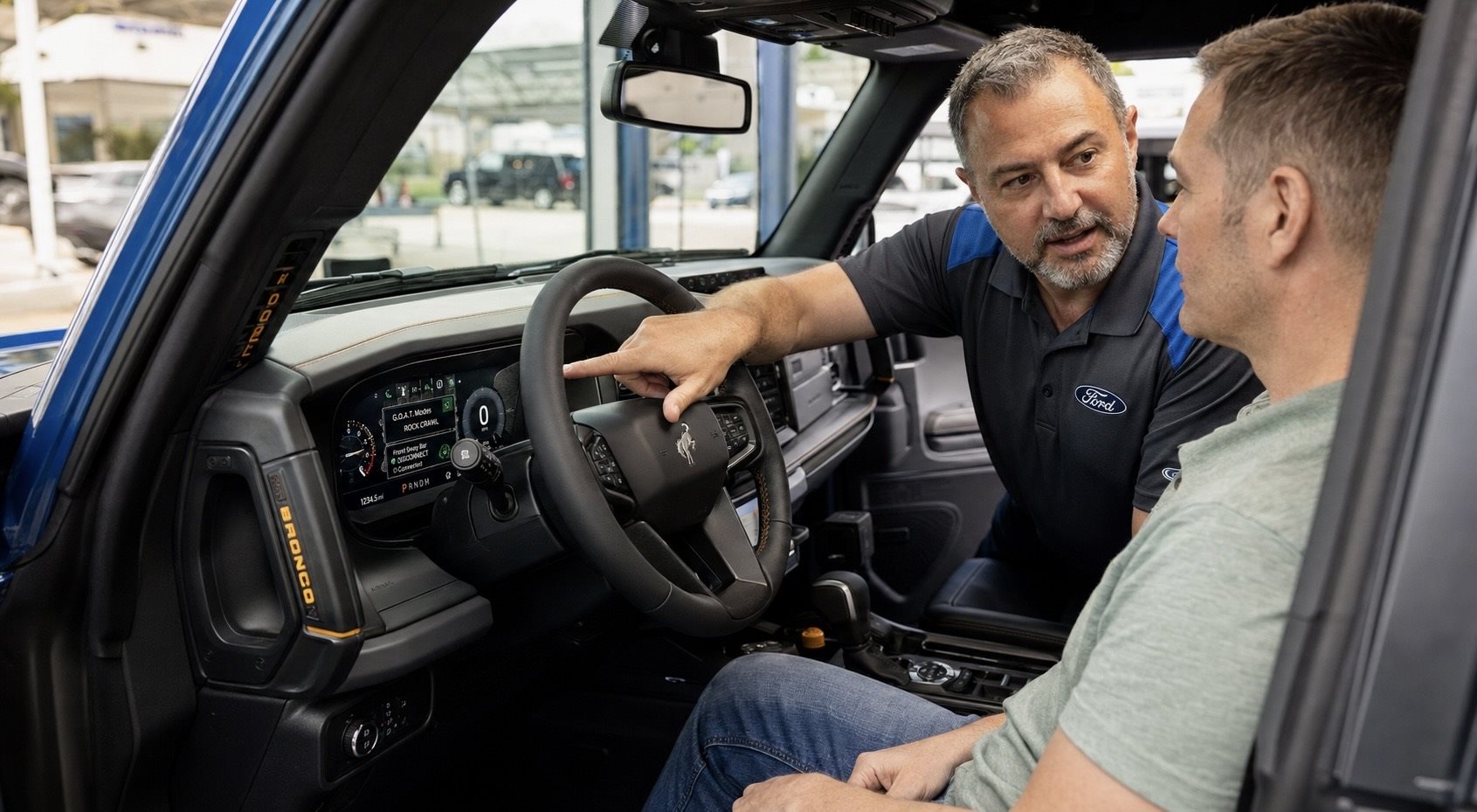
This is the section that separates a Bronco dashboard from every other Ford in our lot, and it's where authorized-dealer knowledge of the platform actually matters - a generic OBD-II scanner or a warning-light chart written for the F-150 won't tell you what these mean.
G.O.A.T. Modes, Trail Control, and locking differentials - informational, not warnings
Available G.O.A.T. Modes (Goes Over Any Terrain) vary by Bronco trim and model year. Depending on configuration, modes can include Normal, Eco, Sport, Slippery, Sand, Off-Road, Rock Crawl, Baja, and other terrain-specific settings. The active mode shown in the cluster is a status indication, not a warning light. Trail Control (low-speed off-road cruise control) and Trail Turn Assist (tightens turning radius via the inside rear brake) each show a simple on/off status icon and require a compatible drivetrain mode to activate. Locking front/rear differentials, available on select trims, show a lock-status icon per axle. When operating normally, these indicators primarily confirm which feature or drivetrain setting is active rather than flagging a fault.
Front sway bar disconnect and the 4x4 transfer case icon
Available on selected Bronco models, including Badlands and Raptor, the front stabilizer bar disconnect improves suspension articulation off-road. Depending on the selected G.O.A.T. Mode, the stabilizer bar reconnects at approximately 30 mph or 50 mph. An amber indicator can simply mean the bar is disconnected, gray indicates standby, while a red stabilizer-bar indicator points to a system fault that should be checked. The transfer case icon shows 4A, 4H, or 4L; a steady icon confirms engagement, while a flashing indicator can mean the requested shift has not yet completed or the required shift conditions have not been met. Follow the message-center instructions; if the condition persists, have the system checked.
Why this matters: Ford IDS/FDRS provides access to Ford-specific modules, diagnostic routines, software updates, and configuration functions that basic OBD-II scanners may not support. For faults involving Bronco-specific drivetrain or chassis systems - the transfer case, front axle disconnect, and locking differentials - Ford-level diagnostic access can be especially useful.
Doors-off and roof-off: what changes on the dashboard
Removing the doors and roof is an engineered feature of the Bronco, but some vehicle functions and alerts can change when components are removed. Follow the removal and reinstallation procedures in the Owner's Manual, reconnect all electrical connectors as specified, and investigate any warning that remains on the message center after the doors or roof have been correctly reinstalled.
Ford Bronco Standard Warning Lights
Beyond the off-road-specific icons, the Bronco carries the same core warning lights as every modern Ford - the ones that matter most for safety.
| Symbol | What It Means | Common Bronco Triggers |
|---|---|---|
| Oil pressure / coolant temp (red) | Low oil pressure or engine overheating | Low oil/coolant, cooling-system leaks, thermostat or cooling-system faults; sustained high-load or low-speed off-road operation can also increase cooling-system demand. Pull over if a critical temperature warning appears. |
| Check engine / wrench (amber) | Emissions, powertrain, or PCM fault set | Short-trip driving, cold starts, moisture, battery-voltage issues, and powertrain sensor faults can all contribute. Because the same indicator can be triggered by many different codes, the vehicle should be scanned before a repair is recommended. Flashing means active misfire - reduce load and book a scan. |
| Tire pressure / TPMS (amber) | One or more tires under-inflated | Common on Sasquatch 35-inch tires after airing down for the trail and not airing back up for street driving. |
| ABS / battery-charging (amber/red) | Brake sensor fault, or alternator not charging | Road salt, moisture, mud, and debris can affect exposed wheel-speed-sensor wiring and connectors, making these areas worth inspecting after winter or off-road use. If the charging system isn't supplying power, the vehicle may eventually shut down once battery voltage falls too low - reduce unnecessary electrical loads and have it checked promptly. |
Safety note: A red engine-oil-pressure, coolant-temperature, brake-system, or other critical warning should be treated as urgent. Stop as soon as it is safe to do so and follow the Owner's Manual instructions for that specific warning. If it happens away from pavement, our Ford Mobile Service can handle routine maintenance, battery checks, and other eligible services at your location - call (779) 243-5517 to find out what we can address on-site versus what needs to come into our Bucktown service bay.
Why Chicago Bronco Owners See Certain Lights More Often
Bronco owners in our service area tend to do something most Ford owners don't: daily city driving in Bucktown, Logan Square, or Lincoln Park combined with weekend trail trips. These conditions can create recurring warning-light patterns for Broncos used for both Chicago commuting and weekend off-road driving. Short-trip driving, cold starts, moisture, battery-voltage issues, and powertrain sensor faults can all contribute to check-engine or wrench warnings on the 2.3L EcoBoost and 2.7L V6 - because the same indicator can be triggered by many different codes, the vehicle should be scanned before a repair is recommended. Broncos used off-road can expose front-axle, stabilizer-bar, wheel-speed-sensor, and related wiring or connectors to road salt, moisture, mud, and debris, and Illinois's calcium chloride and rock salt can accelerate corrosion on affected connectors. Cold weather significantly reduces 12V battery performance, while auxiliary lighting, winches, and other accessories can increase electrical demand. These same conditions are worth inspecting when an ABS or AdvanceTrac warning appears after winter or off-road use.
How to Clear Bronco Warning Lights
Tire pressure, a flashing 4x4 icon, and doors-off/roof-off messages typically clear on their own once the underlying condition is resolved - tires reinflated, a clean shift attempt, or panels reinstalled. Check-engine, wrench, ABS, and stabilizer-bar faults should be diagnosed before codes are cleared. Ford IDS/FDRS provides access to Ford-specific modules, diagnostic routines, configuration functions, and software updates that basic OBD-II scanners may not support.
To reset the oil-life monitor after an oil change, use the steering-wheel controls to open Settings > Vehicle Maintenance > Oil Life Reset, then press and hold OK until the instrument cluster displays "Reset Successful." The remaining oil life should then show 100%. Menu wording can vary slightly by model year and software version. The reset is included whenever service is performed at Murgado Ford.
Dealer vs. Independent Shop: When Each Is Right for a Bronco
We're a Ford dealer, so this is the section most readers expect us to slant. We won't.
An independent shop - even a good off-road specialist - is fine for: Oil changes, tire rotations, basic TPMS resets, aftermarket bumper or winch installation, and general suspension work on aftermarket lift components.
A Ford dealer is worth considering for: Faults involving the electromechanical front axle disconnect, locking differentials, transfer case diagnostics, and G.O.A.T. Mode or Trail Control malfunctions - Ford IDS/FDRS provides access to Ford-specific modules, diagnostic routines, and software updates that basic OBD-II scanners may not support. For warranty-covered repairs and Ford Protect claims, a Ford dealer can also handle the diagnosis and documentation directly within Ford's service system. Routine maintenance performed by an independent repair facility does not, by itself, void a vehicle's factory warranty; owners should retain maintenance records and follow Ford's required service schedule.
Our Quick Lane® express service can often handle routine maintenance without an appointment, and our Ford Mobile Service can often handle routine maintenance, battery checks, and other eligible services at your location - call to find out what we can address on-site versus what may need to come into our Bucktown service bay.
What Bronco Service Costs at Murgado Ford
Service offers change regularly. Visit our service specials page for the latest available pricing, eligibility requirements, and expiration dates before scheduling. Murgado Ford of Chicago's current specials typically include oil change and multi-point inspection bundles, Wild Card tiered savings, complimentary pickup and delivery, and a tire price guarantee - exact pricing and terms are confirmed on the specials page and at the time of booking.
For diagnostic work on off-road-specific systems - transfer case, locking differentials, sway bar disconnect - call (779) 243-5517 for a written estimate before bringing the vehicle in.
Frequently Asked Questions
Is the G.O.A.T. Mode icon on my Bronco a warning light?
No. It's purely informational and simply confirms which terrain mode is currently selected. It never turns amber or red on its own.
The front sway bar disconnect indicator is on. Is that a problem?
The indicator color matters. Amber indicates that the stabilizer bar is disconnected, while gray indicates connected/standby status. A red stabilizer-bar indicator means the system has detected a fault and should be checked. Reconnection behavior can also vary with the selected G.O.A.T. Mode.
Why is my TPMS light on after a trail trip?
Most likely you aired down for the trail and haven't aired back up for street driving - especially common on Sasquatch-package Broncos running 35-inch tires.
Does off-roading void my Bronco's warranty?
Recreational off-road use does not automatically void the entire factory warranty. However, damage caused by misuse, accidents, racing, improper modifications, or an aftermarket component may not be covered. Warranty decisions are made based on the cause of the specific failure and the applicable Ford warranty terms.
Schedule Your Bronco Service in Chicago
If a Bronco warning light or off-road indicator has you wondering whether it needs attention, our Ford-certified team can tell you which in one phone call - and handle the scan, software update, or off-road system diagnostic in one visit if it needs one.
Service Department: (779) 243-5517
Service Hours: Monday-Friday 7:00 AM - 7:00 PM | Saturday 7:30 AM - 3:00 PM | Sunday: Closed
Address: 2501 N Elston Ave, Chicago, IL 60647 (Bucktown - Kennedy Expressway at the Elston exit)
Dashboard warning lights, off-road system behavior, and service needs vary by trim, package, driving conditions, and software version. Final service recommendations may vary by vehicle condition and service advisor assessment. For diagnosis specific to your Bronco, consult a Ford-certified technician at Murgado Ford of Chicago. Offer terms and pricing subject to change - verify current specials on our service specials page before booking.
About Murgado Ford of Chicago Service Center
Murgado Ford of Chicago is a factory-authorized Ford dealer serving Chicago and Cook County, operated by Murgado Automotive Group from 2501 N Elston Ave in Bucktown. Our service department is staffed by Ford-certified technicians using Ford IDS and FDRS diagnostic systems and Genuine Ford Motorcraft Parts, including on the Bronco's off-road-specific drivetrain systems - electromechanical front axle disconnect, locking differentials, and transfer case electronics. We also offer Quick Lane® express service and Ford Mobile Service at your home or office.
This guide reflects diagnostic patterns commonly observed in our Bucktown service bay and is intended as educational information. For diagnosis specific to your vehicle, consult a Ford-certified technician. Service offers and eligibility requirements are subject to change. Verify current specials directly with Murgado Ford of Chicago before scheduling. Published 2026-08-26 · Last reviewed 2026-08-26.