
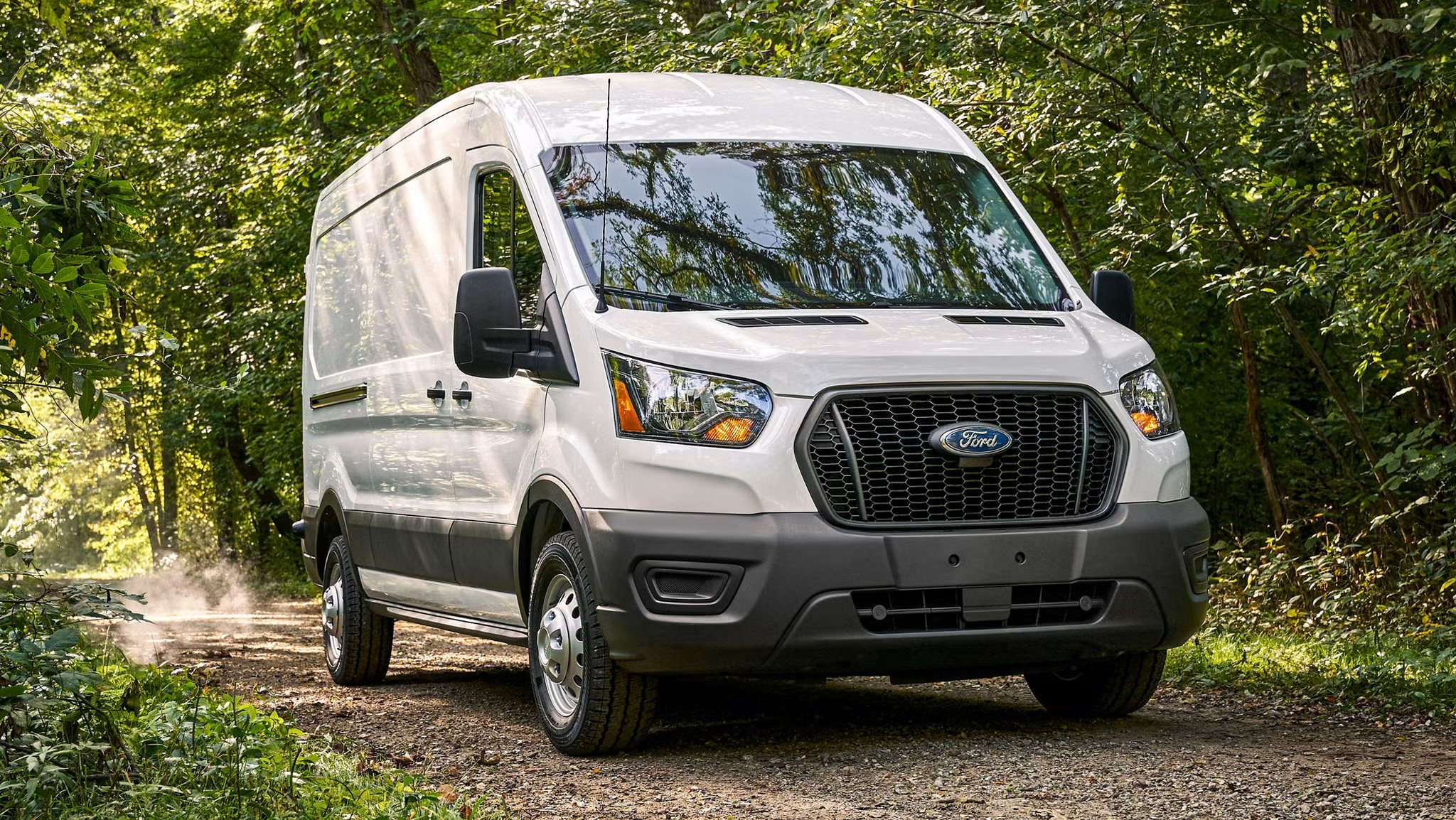
Ford Transit roof height on the 2026 cargo van runs from 82.2 inches with the low roof to 110.4 inches with the high roof, and the load floor sits under 29 inches at curb. Here is how to match a Transit or E-Transit to your doors, your loading dock and your tax year, using Ford's published 2026 figures and the IRS rules for Section 179.
At a glance
- Three roofs, five heights. Ford lists the 2026 Transit cargo van from 82.2 inches tall (Regular Low) to 110.4 inches (Extended High). Racks and upfits add to that.
- The load floor is under 29 inches. Ford lists a load height (curb) of 28.0 to 28.9 inches. Measure your dock and compare before you order.
- The E-Transit is built differently. It comes in low, medium and high roofs, but it uses its own rear suspension. Measure the actual E-Transit instead of borrowing gas Transit numbers.
- Section 179 runs on the placed-in-service date. The IRS counts a van as placed in service when it is ready and available for its specific use. Our plain reading is that ordering alone does not count. A tax professional confirms what applies to you.
How tall is a 2026 Ford Transit with each roof height?
Ford Transit roof height on the 2026 cargo van runs from 82.2 inches with the low roof to 110.4 inches with the high roof. The low roof measures 82.2 to 82.9 inches, the medium roof 101.3 inches and the high roof 109.6 to 110.4 inches. Those are the overall heights in Ford's 2026 Transit technical specifications.
Ford pairs each roof with specific lengths. The Regular length rides on a 129.9-inch wheelbase. The Long and Extended lengths use a 147.6-inch wheelbase. The table shows what Ford publishes for each cargo van body.
| Body | Overall height | Max cargo height | Load height (curb) | Rear door opening height |
|---|---|---|---|---|
| Regular Low | 82.2 in | 56.9 in | 28.9 in | 49.5 in |
| Long Low | 82.9 in | 56.9 in | 28.7 in | 49.5 in |
| Long Medium | 101.3 in | 72.0 in | 28.7 in | 64.9 in |
| Long High | 109.6 in | 81.5 in | 28.7 in | 74.3 in |
| Extended High (single rear wheel) | 110.4 in | 81.5 in | 28.0 in | 74.3 in |
Source: Ford, 2026 Ford Transit Technical Specifications, reviewed 10/14/2026. Ford does not state a load condition for overall height. Height and load height vary with series, equipment, tires and load. Rear door opening width is 61.7 inches on every body.
Two details matter when you read the table. First, height changes with equipment, so a roof rack, ladder rack or upfit sits on top of these figures. Second, Ford's own site now shows the 2027 cargo van, with overall heights listed from 82.7 to 110.4 inches. Confirm the model year of the exact van you are buying. Our 2026 Ford commercial and fleet guide covers series, wheelbases and upfit planning.
Which Transit roof height fits the work you do?
Pick the roof from three measurements: your tallest door or garage, what you load through the rear doors, and whether your crew stands inside. Roof choice also limits length. Ford offers the low roof on the Regular and Long lengths. The medium roof comes on the Long length only, and the high roof on the Long and Extended lengths.
- Low roof. The lowest overall height, at 82.2 to 82.9 inches. Max cargo height is 56.9 inches and the rear door opening is 49.5 inches tall.
- Medium roof. Long length only, 101.3 inches overall. Max cargo height rises to 72.0 inches, and the rear door opening to 64.9 inches.
- High roof. 109.6 or 110.4 inches overall, with 81.5 inches of max cargo height. The rear door opening is 74.3 inches tall.
- Side door. The sliding door opening is 51.2 inches wide. Its height is 49.6 inches on the low roof and 63.0 inches on medium and high roofs.
Rear door swing changes with roof height too. Ford lists a 180-degree rear door opening as standard on low and medium roof cargo vans. A 253-degree opening is standard on high roof vans and optional on low and medium roofs. Ford's 2026 order guide notes that the 253-degree door is not available on the 130-inch wheelbase. Compare bodies on our 2026 Transit cargo van research page or the Ford Transit model research overview.
Is the Ford E-Transit the same height as the gas Transit?
Do not assume it is. The E-Transit shares the roof names but has its own rear suspension, so measure the actual van. Ford's 2026 order guide lists the E-Transit cargo van in low, medium and high roof on the Long body, plus an Extended high roof. All four E-Transit body codes in that guide are rear-wheel drive. The same guide lists an independent rear suspension with coil springs and marks it "E-Transit only." That difference is why we do not reuse gas Transit heights or load heights for the electric van.
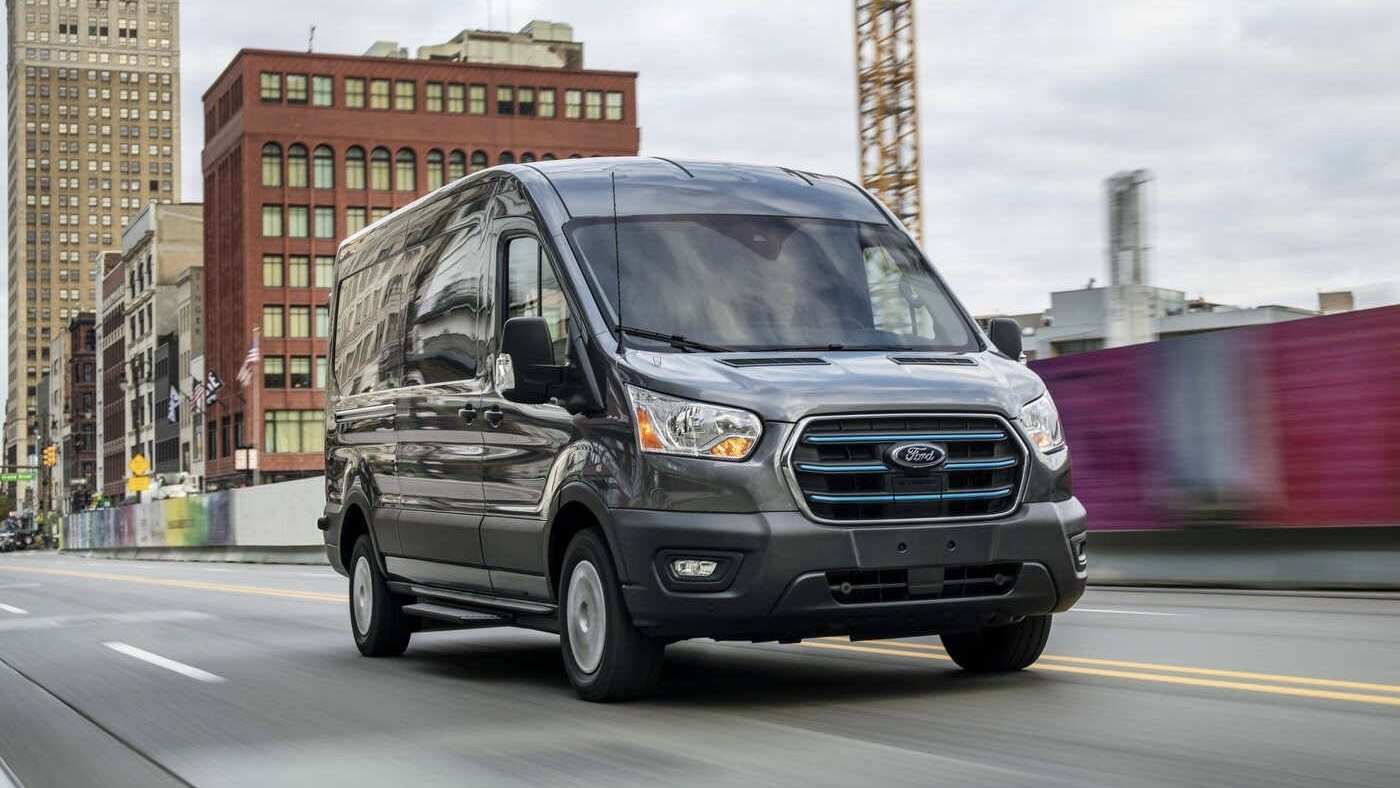
For 2026, Ford lists the E-Transit with Enhanced Range with an 89 kWh high-voltage battery and a motor rated at 198 kW, 266 horsepower and 317 lb.-ft. Ford also made a vapor injection heat pump standard on the E-Transit for 2026, and Close Assist standard on medium and high roof models. Ford cites up to 487 cubic feet of cargo volume.
Browse the new Ford E-Transit, the 2026 E-Transit cargo van research page and our E-Transit model research. For charging and battery service questions, see Ford EV services.
Will a Ford Transit line up with your loading dock?
Measure your dock and compare it with Ford's 28.0 to 28.9 inch load height (curb) for the gas Transit before you order. Ford labels that figure "load height (curb)," so it describes the van at curb weight. A loaded van can sit differently, which is our general advice, not a Ford figure. We could not find one published standard dock height, so measure yours. These steps take one tape measure.
- Measure the dock. Measure from the pavement where the van parks up to the dock floor at the door your crew uses.
- Subtract the van's load height. Use Ford's 28.0 to 28.9 inch load height (curb) for the gas Transit body you are considering. Note the gap between the two.
- Check what you load. Compare your tallest cart, pallet or rack with the rear door opening: 49.5, 64.9 or 74.3 inches tall by 61.7 inches wide.
- Plan the door swing. Decide if the rear doors must fold back against the body at the dock. If so, ask about the 253-degree rear door. It is standard on high roof vans, and Ford's order guide says it is not available on the 130-inch wheelbase.
- Measure loaded. Recheck the gap with a typical load aboard, since Ford's figure is a curb figure.
- Measure the E-Transit itself. If you are leaning electric, measure a 2026 E-Transit in the body you want. Ford's gas Transit figures do not apply to it.
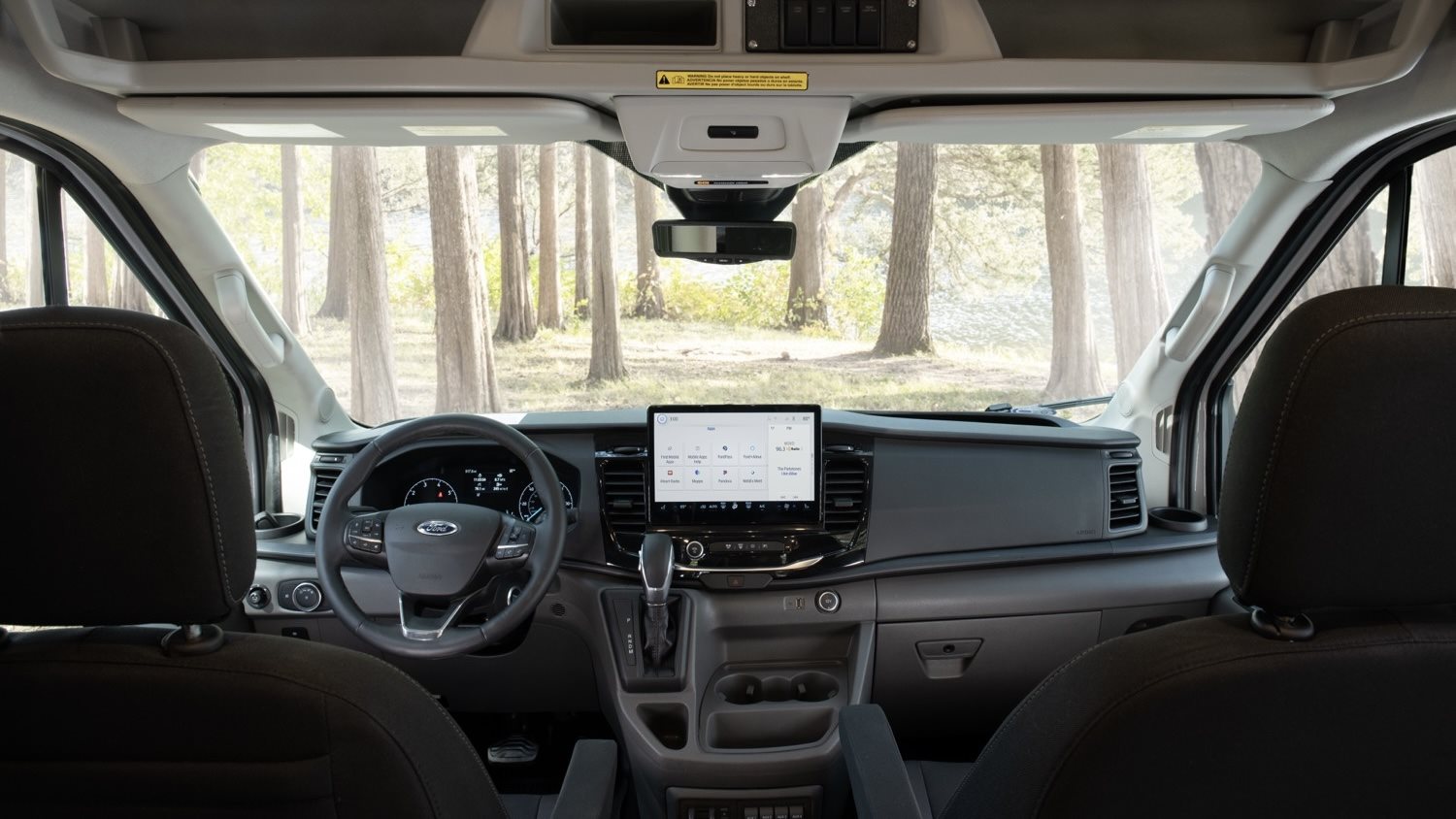
Bring your dock and door measurements when you talk with our sales team at 779-244-6471. Our fleet guide puts the order of decisions this way: "Bring the upfitter into the conversation before the chassis is ordered, not after."
How do you check clearance for a Transit on Chicago streets?
Read the posted clearance sign at each viaduct, and measure any garage or loading door your van will use. The Chicago Department of Transportation says viaduct clearance heights are posted on signs at each viaduct. CDOT calls the clearances in its list "a guideline" and "advisory only." In that list, NP means not posted, with a clearance over 14 feet 6 inches. See the CDOT viaduct clearances page, and obey the sign on the structure.
Convert your van to feet before the first route. A 2026 Long High Transit at 109.6 inches is about 9 feet 2 inches. A Long Medium at 101.3 inches is about 8 feet 5 inches. A low roof at 82.2 inches is about 6 feet 10 inches. Add anything mounted on the roof, then write the total on a label inside the cab.
Width matters at garage doors and alley entrances. Ford lists the 2026 cargo van at 81.3 inches wide without mirrors (83.7 on the Extended dual rear wheel van). It is 97.4 inches with mirrors, or 83.2 inches folded. Its curb-to-curb turning circle is 43.5 feet on the 130-inch wheelbase and 48.5 feet on the 148-inch wheelbase.
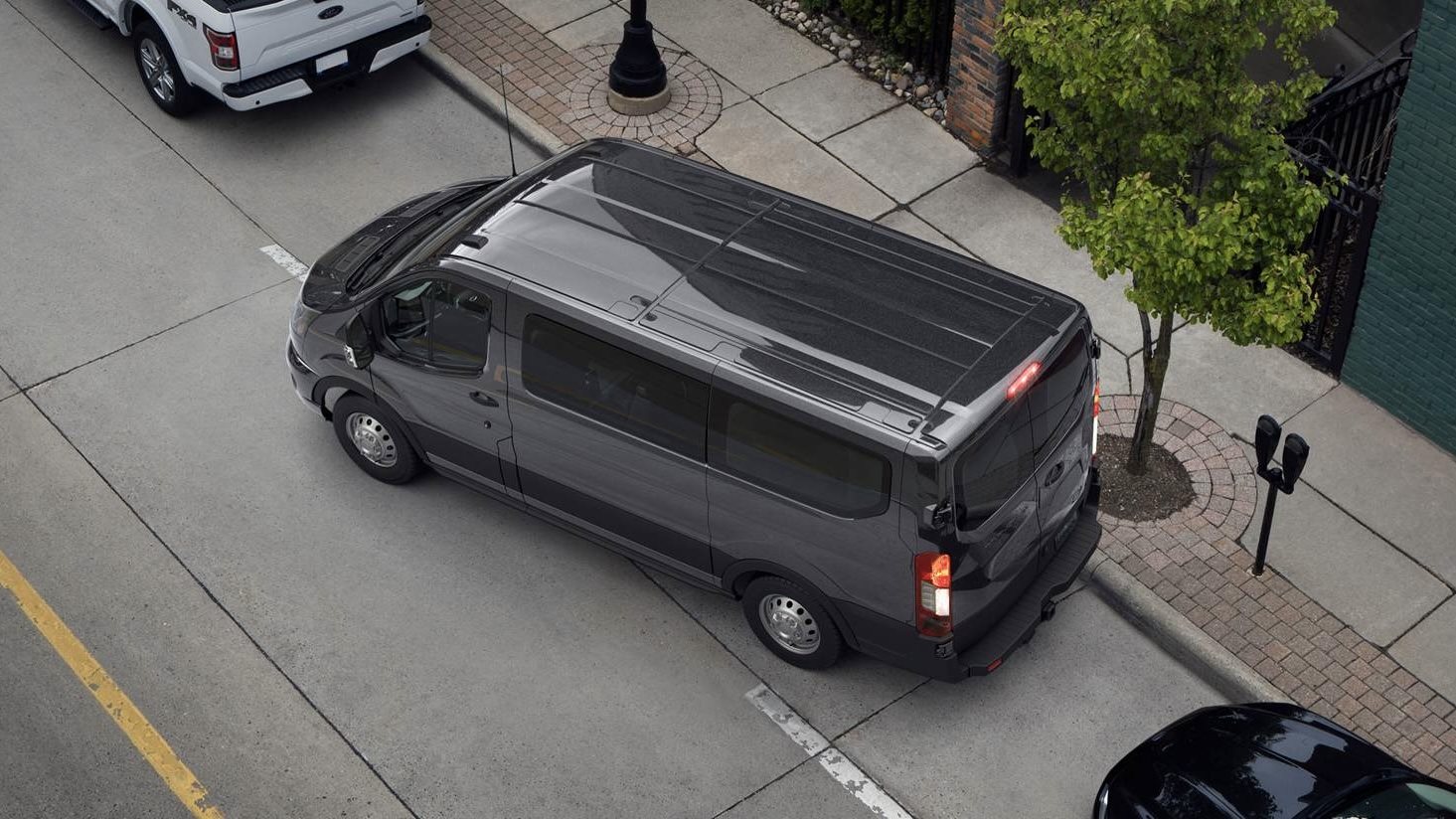
Chicago conditions also shape ownership. Road salt runs from November through March, and freeze-thaw potholes follow in March and April. Our fleet service page, Quick Lane and Ford Mobile Service are the starting points for keeping work vans on the road. You can also schedule service online.
Is the Ford Transit heavy enough to matter for Section 179?
Every 2026 Transit cargo van GVWR that Ford lists is above 6,000 pounds, the line the IRS uses for trucks and vans. The IRS defines a passenger automobile as a vehicle "rated at 6,000 pounds or less of gross vehicle weight for trucks and vans." Ford lists 8,670 to 8,800 pounds for the T-150, 9,070 to 9,150 for the T-250 and 9,500 for the T-350. The T-350HD runs from 9,950 to 11,000 pounds.
For an E-Transit, read the GVWR on the Safety Compliance Certification Label of the specific van. Our 2026 commercial and fleet guide covers GVWR by series in more depth.
Clearing 6,000 pounds does not settle the question. IRS Publication 946 notes that heavier vehicles "are still 'other property used for transportation'" and remain subject to the listed property rules. The tax code also caps Section 179 for some vehicles up to 14,000 pounds GVWR, with three exceptions.
26 U.S.C. 179(b)(5)(B): vehicles excluded from the cap. The statute's definition "does not include any vehicle which" meets one of three tests. The vehicle "(I) is designed to have a seating capacity of more than 9 persons behind the driver's seat, (II) is equipped with a cargo area of at least 6 feet in interior length which is an open area or is designed for use as an open area but is enclosed by a cap and is not readily accessible directly from the passenger compartment, or (III) has an integral enclosure, fully enclosing the driver compartment and load carrying device, does not have seating rearward of the driver's seat, and has no body section protruding more than 30 inches ahead of the leading edge of the windshield." Source: 26 U.S.C. 179(b)(5)(B)(ii).
Whether a given van meets one of these tests depends on how it is built and equipped. That is a question for your tax professional, with the window sticker and build sheet in hand.
When does a Transit count as placed in service for Section 179?
When it is "ready and available for a specific use," per the IRS. The deduction follows the year the van is placed in service. IRS Publication 946 adds that property is in service when it is ready and available for its specific use, even if you are not using it yet. The Section 179 limit applies to property placed in service during the tax year. Our plain reading is that signing an order is not the same as placing a van in service.
- Calendar-year businesses. The tax year ends December 31, so the placed-in-service date decides which year's return the van belongs to.
- Upfits. If the van needs shelving, a partition or a rack before it can do its job, ask your tax professional when it becomes "ready and available."
- Ordered vans. Ask our sales team for the expected timing on the specific van, and share it with your accountant early.
- Records. Keep the delivery paperwork and any upfit invoice that shows when the van was ready for work.
Our fleet guide says: "Murgado Ford of Chicago is not a tax advisor and does not provide tax, legal or accounting advice." Read the IRS rules in Publication 946.
What other tax rules affect a Transit or E-Transit bought in 2026?
Five other IRS rules can matter: business use above 50 percent, a taxable income limit, possible recapture, bonus depreciation and the end of the 45W credit. The IRS adjusts the Section 179 dollar limits each year. The limits for tax years beginning in 2026 are in Revenue Procedure 2025-32. The other rules are summarized below.
| Rule | What the IRS says |
|---|---|
| Business use | Section 179 is available only if the property is used more than 50% for business in the year it is placed in service. |
| Recapture | The deduction may have to be recaptured if business use drops to 50% or less in any year of the recovery period. |
| Income limit | The deduction is limited to taxable income from the active conduct of any trade or business during the year. |
| Bonus depreciation | 100% special allowance for qualified property acquired and placed in service after January 19, 2025, unless you elect out. A 40% election exists for the first tax year ending after that date. |
| 45W credit (E-Transit) | The commercial clean vehicle credit is not available for vehicles acquired after September 30, 2025. |
Sources: IRS Publication 946 (2025) and IRS commercial clean vehicle credit page, reviewed 10/14/2026. General information only; your tax professional applies these rules to your return.
For the E-Transit, the 45W change means the credit no longer applies to a van acquired now. Read the IRS commercial clean vehicle credit page. Financing questions go to our financing application.
How do you spec a Transit or E-Transit with Murgado Ford of Chicago?
Start with the job and your measurements, then settle series, roof, length and upfit before the trim. Our commercial guide sets the order: "Series, roof, wheelbase, axle and upfit get settled before anyone talks about a trim name." Bring three things: your tallest door or garage clearance, your dock height and the heaviest load you carry.
Then compare the new Ford Transit and the E-Transit, and see the Transit cargo van offers on our specials page (check each offer's end date). If your work outgrows a van, our Super Duty pages cover heavier trucks. Questions before you visit can go through our contact page. For maintenance after delivery, start at our service department page.
Frequently Asked Questions
How tall is a Ford Transit high roof in feet?
Ford lists the 2026 Long High Transit cargo van at 109.6 inches overall, about 9 feet 2 inches. The Extended High is 110.4 inches, also about 9 feet 2 inches. Anything mounted on the roof, such as a ladder rack, adds height. Measure the finished van and post the total inside the cab.
What else is different about the 2026 E-Transit?
Ford lists a 75-mph governed top speed as standard on the 2026 E-Transit cargo van. A single onboard charger is standard, and a dual onboard charger is optional. Ford also made a vapor injection heat pump standard for 2026. Ask our sales team which charger setup suits where your vans park overnight.
How wide is a Ford Transit with the mirrors out?
Ford lists the 2026 Transit cargo van at 97.4 inches wide including mirrors and 81.3 inches without them. Folding the mirrors brings the width to 83.2 inches. The Extended dual rear wheel van is wider, at 83.7 inches without mirrors. Check both widths against garage doors and alley entrances.
What is the Transit turning circle for tight city streets?
Ford lists a curb-to-curb turning circle of 43.5 feet for the 2026 Transit on the 130-inch wheelbase. The 148-inch wheelbase needs 48.5 feet. If your crew works tight blocks or alleys, the shorter wheelbase turns in noticeably less space. Weigh that against the cargo room the longer body adds.
Does shelving or company lettering change how the IRS views a van?
It can. IRS Publication 946 says qualified nonpersonal use vehicles include vans "specially modified so that they are not likely to be used more than a minimal amount for personal purposes, such as by installation of permanent shelving and painting the vehicle to display advertising or the company's name." Ask your tax professional how that applies to your van.
Where do I find the GVWR and payload of a specific van?
Read the Safety Compliance Certification Label on the door jamb of that exact van. Ford lists 2026 Transit cargo van maximum payload up to 5,103 pounds on a T-350HD dual rear wheel van. Ford says payload "varies and is based on accessories and vehicle configuration. See label on doorjamb for carrying capacity of a specific vehicle."
Can I still get the 45W credit on a new E-Transit?
No, not for a van acquired now. The IRS says the commercial clean vehicle credit is not available for vehicles acquired after September 30, 2025. Other tax rules, such as depreciation, may still apply to a business E-Transit. Ask your tax professional how they apply to your purchase.
What happens if I stop using the van mostly for business?
You may owe some of the deduction back. The IRS says you may have to recapture the Section 179 deduction if business use drops to 50% or less in any year of the recovery period. Keep mileage and use records for each van from the day it is placed in service.
Do the Section 179 limits change every year?
Yes. The IRS adjusts the Section 179 dollar limits for inflation each year and publishes them in a revenue procedure. The limits for tax years beginning in 2026 are in Revenue Procedure 2025-32. The deduction is also limited by your taxable business income for the year, so the usable amount varies.
Is the 2026 or 2027 Transit the one to measure?
Measure the model year you are buying. Ford's 2026 specifications list overall heights from 82.2 to 110.4 inches. Ford's site now shows the 2027 cargo van, with heights listed from 82.7 to 110.4 inches. Check the window sticker for the model year, then use that year's figures.
Bring Your Measurements to N Elston Ave
Our sales team is at 2501 N Elston Ave in Chicago. Bring your door, garage and dock measurements, plus your upfitter's notes, and ask our team to compare Transit and E-Transit bodies against them.
Sales: 779-244-6471
Sales hours: Monday-Friday 9:00 AM - 8:00 PM | Saturday 9:00 AM - 7:00 PM | Sunday closed
Shop the Ford TransitSee Transit Offers
About This Guide
Prepared by the sales team at Murgado Ford of Chicago, 2501 N Elston Ave, Chicago, IL 60647, part of the Murgado Automotive Group.
Sources reviewed 10/14/2026: Ford, 2026 Ford Transit Technical Specifications; Ford, 2026 Transit order guide (major product changes); Ford, What's New: 2026 Ford Transit; Ford Pro fact sheet, Ford Transit and E-Transit; ford.com 2027 Transit Cargo Van page; City of Chicago CDOT viaduct clearances; 26 U.S.C. 179; IRS Publication 946 (2025); IRS Revenue Procedure 2025-32; IRS commercial clean vehicle credit page. Ford documents govern vehicle specifications; dimensions vary by configuration, equipment and load. E-Transit dimensions are not stated here; measure the specific vehicle. Tax information is general and not tax, legal or accounting advice; Murgado Ford of Chicago is not a tax advisor. Consult your tax professional. No endorsement by the IRS or the City of Chicago is implied. This page states no prices. Ford, Transit and E-Transit are trademarks of Ford Motor Company. Published and last reviewed October 14, 2026.